Torriden Dive-In Serum Review: Who Is It For?
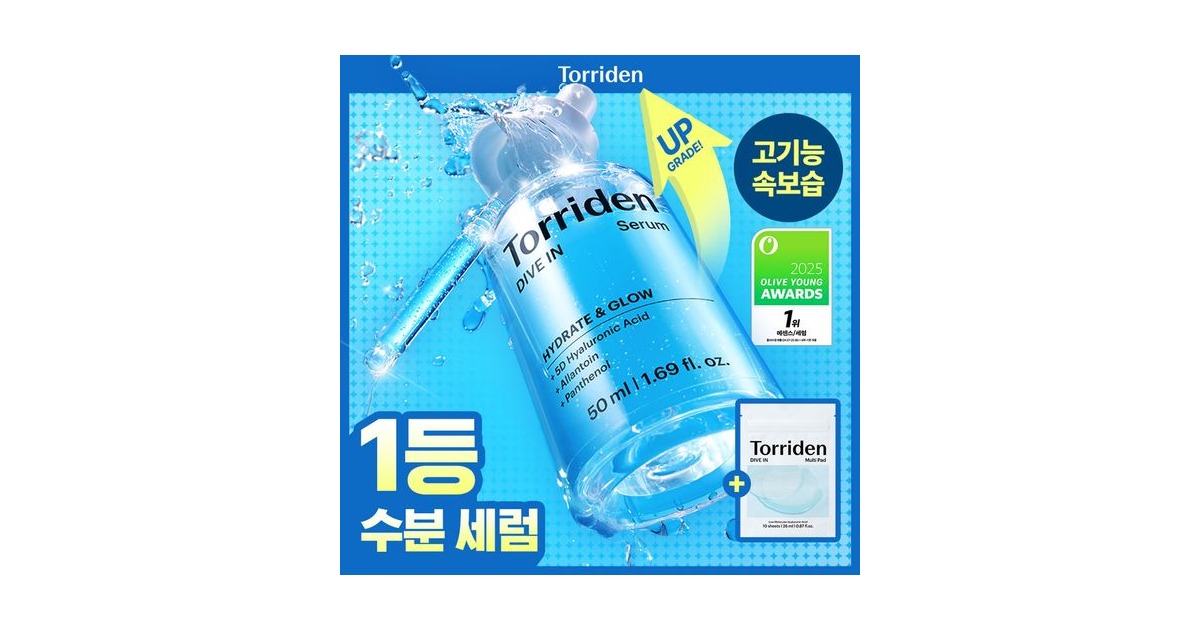
Short answer: Torriden Dive-In Serum is a strong match for people who want light, low-stickiness hydration, especially oily, combination, or dehydrated skin. It is less convincing as a stand-alone moisturizer for very dry skin. This is a Korean review roundup, not a personal wear test: Olive Young facts are checked against twelve Korean blog reviews, with sponsored posts removed.
What is Torriden Dive-In Serum?
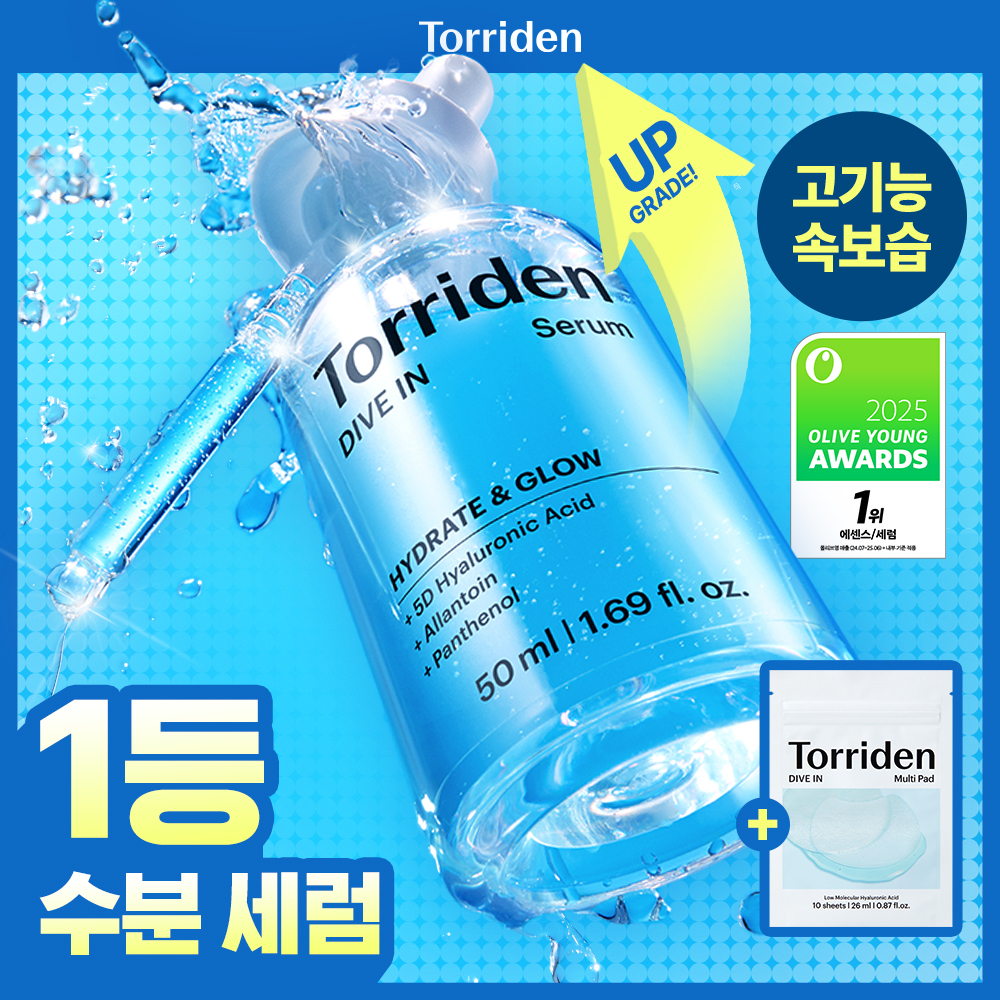
The product reviewed here is the upgraded Torriden Dive In Low Molecular Hyaluronic Acid Serum 50ml Set (+Multi Pad 10 Sheets). The product page lists the serum as a 50ml set with ten multi pads. The bottle is positioned as a hydrating serum rather than an oil-rich cream: a middle step for adding water-based moisture before a moisturizer.
On the same Olive Young Global listing, the Korean review tab contained 221 reviews with a distribution-weighted average of 4.8/5 when checked on August 26, 2026. That rating is useful context, but it is still a retailer snapshot rather than a promise of personal results.
That distinction matters. “Hydrating” and “moisturizing” are often used interchangeably in English skincare content, but the Korean reviews in this sample describe a more specific job. They like the serum for relieving a tight, dry feeling without adding a heavy film. When the weather is cold or the skin is very dry, several reviewers put cream over it or apply a second thin layer.
The sample was collected from Korean Naver blogs on August 26, 2026. It includes twelve posts that did not display a sponsorship, paid-placement, or affiliate disclosure in the page text. Three commercial posts were excluded: two Olive Young curator posts and one post with an advertising disclosure. The review count below therefore describes this twelve-post sample, not every Korean customer.
What does the brand claim?
Olive Young’s product detail page makes four central claims. First, the formula uses five types of hyaluronic acid in different molecular sizes. The detailed copy names high-, middle-, and low-molecular-weight forms and describes a moisture-barrier role for the larger forms and hydration support underneath the skin for smaller forms. That is brand copy, not proof that every user will experience the same result.
Second, Olive Young highlights panthenol and allantoin alongside the hyaluronic acid. The page presents panthenol as supporting the moisture barrier and allantoin as supporting calming hydration. The wording supports a gentle-care position; it does not justify saying that the serum treats acne, eczema, redness, or another medical condition.
Third, the page says the serum has a mildly acidic formula, a refreshing non-sticky finish, and a completed skin-irritation test on sensitive skin. It also presents a claim of improved surface and deeper moisture lasting up to 48 hours. Those statements belong to the brand’s product description and should be read as tested or marketing claims tied to its own conditions, not a promise for an individual face.
Fourth, the detailed page describes a 2019 clinical test on stratum-corneum moisture with 22 subjects and a historical Olive Young number-one serum claim between 2019 and 2021. These are dated claims in the page copy, not current bestseller rankings. The current product page is for an upgraded package, so readers should not confuse the older ranking language with a 2026 position.
The use instruction is simple: dispense an appropriate amount, spread evenly, and pat gently to absorb. The same detail copy says the formula can be layered once or twice more. That instruction lines up with the reviewers who use a thin first layer and add more only to dry areas.
What do Korean reviewers actually say?
The twelve-review sample is unusually consistent on texture. Twelve of twelve mention hydration or relief from a dry, tight feeling as the main reason to keep the serum in a routine. Eleven of twelve describe some combination of light texture, quick absorption, low stickiness, or a clean finish. Several say it sits comfortably under makeup or other skincare.
The agreement weakens around how much moisture is enough. Five of twelve say, directly or indirectly, that very dry skin, winter, or dry areas may need a cream, another layer, or a richer routine. This is the most repeated limitation in the sample. The serum is praised for not feeling heavy, but that same lightness can feel insufficient when the goal is long-lasting comfort without another product.
The texture descriptions are practical rather than dramatic. Reviewers call it a clear, fluid serum that initially feels like a small amount of slip and then becomes more watery as it spreads. The repeated sequence is: easy to distribute, quick to settle, little residue. That supports the Olive Young claim of a refreshing, non-sticky finish, although it remains a set of user observations rather than a laboratory measurement.
Skin type changes the verdict. The sensitive-dry reviewer valued the lack of obvious irritation but still warned that the formula could be too light for extremely dry conditions. The oily, acne-prone reviewer liked the low-oil feel and long-term repeat use. Combination or dehydrated-oily reviewers also favored it because they could add hydration without making the face feel coated. A dry-skin reviewer placed it more comfortably in a morning routine than as the final night layer.
One reviewer described using it before retinol, which makes sense as a routine preference, not as a safety guarantee. Another reported applying it around occasional blemishes and seeing them settle, but that is an individual observation and is not evidence that the serum treats acne. This roundup keeps that distinction visible because skincare reviews can easily turn a personal impression into an unsupported medical claim.
The sample also gives a useful brand-versus-user comparison. Olive Young sells the idea of multi-weight hyaluronic acid, mild acidity, and lasting hydration. Korean reviewers confirm the accessible part of that story: the serum feels hydrating, light, and easy to layer. They do not confirm a universal 48-hour result. Instead, their recurring advice is conditional: use a thin layer for daily hydration, then add cream or another layer when the skin still feels dry.
What are the main advantages and drawbacks?
The strongest advantage is routine compatibility. A serum that absorbs quickly and does not leave much tack can be used in the morning, under sunscreen and makeup, or in a layered evening routine. The reviewers also repeatedly value the option to reapply without feeling buried under product. That makes the formula attractive to people who dislike the usual sticky reputation of hyaluronic-acid products.
The second advantage is flexibility across seasons and skin types, within limits. Oily and combination reviewers can use it as a hydration step without adding much oiliness. Sensitive-skin reviewers describe it as comfortable, though “comfortable for these reviewers” is the accurate boundary. The formula’s panthenol and allantoin story also gives the product a calmer, less aggressive identity than an exfoliating or high-active serum.
The main drawback is not that it is sticky or difficult to use. It is the opposite: it can be too light on its own. Five of twelve reviewers point toward a cream, layering, or a richer companion product for very dry skin or dry weather. If your preferred routine is one serum and nothing else, this is the question to answer before purchase.
A second limitation is evidence scope. The Olive Young page contains useful product claims, but the accessible fact text does not provide a complete current INCI list. It identifies the featured ingredients—five hyaluronic acid types, panthenol, and allantoin—rather than giving a full ingredient-by-ingredient analysis. Anyone avoiding a specific ingredient should read the package panel or current retailer listing before ordering.
Who is it for, and who should skip it?
Choose it if you want:
- a lightweight hydration layer for oily, combination, or dehydrated skin;
- a serum that settles quickly before sunscreen or makeup;
- low-stickiness texture and easy layering;
- a simple formula story built around five hyaluronic acid types, panthenol, and allantoin;
- a product you can adjust by using one thin layer or adding more to dry areas.
Consider skipping it, or pair it with a cream, if you want:
- a rich, occlusive night moisturizer in one step;
- a heavy protective film for very dry winter skin;
- a full current INCI analysis based only on the retailer’s accessible text;
- a product chosen to treat acne, redness, or another medical concern.
For reactive skin, patch testing is still the sensible starting point. “Sensitive skin irritation test completed” is a brand claim about a test, not an individual guarantee. Apply a small amount to a limited area, introduce no other new product at the same time, and stop if irritation appears.
The most useful routine placement is after cleansing or toner and before cream. In the morning, sunscreen remains the final skincare step. At night, use cream over the serum if your skin still feels tight after it absorbs. That approach matches both the official application direction and the recurring reviewer caveat.
How much does it cost and where can you buy it?
On Olive Young Global, the checked set was listed at a regular price of US$26 and a sale price of US$19.50 on August 26, 2026. The set contains the upgraded 50ml serum and ten multi pads. Price and stock can change after that check, so treat the figures as a dated snapshot rather than a permanent price promise.
The product page is Torriden Dive In Low Molecular Hyaluronic Acid Serum 50ml Set on Olive Young Global. The set is the more practical choice if the multi pads will actually enter your routine. If you only want a serum and already have pads at home, compare the current single-bottle listing before paying for the bundle.
For a broader routine context, see The Korean Skincare Routine, According to Actual Koreans. The useful takeaway there is simple: a short routine that gets repeated usually matters more than copying every product in a trend cycle.
What should you know before deciding?
Torriden Dive-In Serum earns its popularity honestly in one narrow but useful way: it makes hydration easy to add. The Korean reviews do not describe a miracle product. They describe a clear, quick-settling serum that helps the skin feel more comfortable without the weight many people dislike.
The buying decision comes down to the trade-off. If your skin is oily, combination, or dehydrated and you want a light daily layer, the evidence is favorable. If your skin is very dry and you want one product to finish the routine, the evidence says to budget for cream or layering. That is a more accurate conclusion than calling it universally suitable for every skin type.
Review sample and source notes
The twelve non-sponsored Korean review pages used for the count are listed below. “Not found” means no sponsorship or paid-placement disclosure was found in the page text checked on August 26, 2026; it is not a claim about private arrangements outside the page.
| Date | Skin type or context | Positive signals | Limitation or negative signal | Source |
|---|---|---|---|---|
| 2026-08-17 | Not stated | Hydration; non-sticky texture | Slightly heavier than some serums | Naver blog |
| 2026-07-18 | Sensitive, dry | Light finish; no irritation reported | Very dry skin may need layering | Naver blog |
| 2026-08-05 | Oily, acne-prone | Low-oil feel; easy absorption | Rich creams were described as difficult, so serum is not a full moisturizer | Naver blog |
| 2026-07-12 | Not stated | Hydration; fresh feel | Review was only after about one week | Naver blog |
| 2024-10-19 | Not stated | Low stickiness; quick absorption | Drier skin may need another base layer | Naver blog |
| 2026-08-07 | Sensitive, dry-leaning | Comfortable use; fast absorption | Cream recommended in dry seasons | Naver blog |
| 2026-07-20 | Not stated | Light texture; little pilling | Very dry skin may find it insufficient alone | Naver blog |
| 2026-06-17 | Not stated | Quick absorption; thin finish | No strong negative recorded | Naver blog |
| 2026-08-09 | Dehydrated-oily | Water-like spread; low residue | Very dry days call for extra layering | Naver blog |
| 2026-06-15 | Not stated | Light summer feel; low stickiness | The post relies partly on brand claims | Naver blog |
| 2026-06-08 | Dry | Morning-friendly absorption; light feel | Too light as a stand-alone night step | Naver blog |
| 2026-06-17 | Not stated | Refined absorption; non-heavy finish | Some evidence comes from brand test language | Naver blog |
Official fact source checked on August 26, 2026: Olive Young Global product detail. Product image source: the official Olive Young CDN image used in the hero image, original product image, checked August 26, 2026.
Frequently asked questions
Is Torriden Dive-In Serum good for dry skin?
It can help dry skin add lightweight hydration, but Korean reviewers repeatedly describe it as a serum rather than a complete moisturizer. Five of the twelve non-sponsored reviews said very dry skin or cold weather may need cream or a second layer. Treat it as a hydration step, then seal it when needed.
Is Torriden Dive-In Serum suitable for oily or combination skin?
The review sample leans positive for oily and combination skin because the serum spreads thinly, absorbs quickly, and leaves little oily residue. Two reviewers specifically identified oily or dehydrated-oily skin. That does not guarantee compatibility, so introduce it on one area first if your skin reacts easily.
Does Torriden Dive-In Serum contain fragrance?
The Olive Young detail page highlights five types of hyaluronic acid, panthenol, and allantoin, but it does not present a full INCI list in the accessible text. One Korean review describes no artificial fragrance. Check the current package ingredient panel before buying, especially if fragrance is a personal trigger.
How should Torriden Dive-In Serum be used?
Olive Young says to dispense an appropriate amount, spread it evenly over the skin, and pat gently until absorbed. The product page also suggests layering once or twice more for extra hydration. In a routine, place it after cleansing or toner and before cream or sunscreen in the morning.
Is the Torriden Dive-In Serum set worth buying?
The set checked on Olive Young Global contains a 50ml serum and ten multi pads. Its listed regular price was US$26 and its sale price was US$19.50 on August 26, 2026. It makes sense if you will use the pads; a single bottle is simpler if you only want the serum.